Start with a name
- Whose name, when you hear it, produces even a small flinch?
- Who do you still argue with in your head, explaining why they were wrong or rehearsing what you should have said?
- Who have you "forgiven," but you still want them to understand how much they hurt you?
If a name showed up, it's still on the books.
"Just let it go" treats it as one job
A common mistake when trying to settle a grudge is treating it as one job: "just let it go" or "just forgive them."
Forgiveness, reconciliation, boundaries, grief, and deciding someone was genuinely in the wrong are separate jobs. A grudge often needs a different one than the one you tried. "Let it go" can be the wrong job for the grudge in front of you.
This is an audit. For each name, you do three things:
- Write the real charge. One line, "What I hold against you is ____." Then a check for the ways people dodge: explaining their reasons, writing "kind of," writing "I'm over it." If you flinched, you write the ugly version underneath.
- Run the Apology Test. Write the exact apology you'd need from that person, in their voice. Read it back. Estimate how much of the resentment is left. Whatever remains is the real charge.
- Give it a job and a first act. Each entry gets a job, sometimes two, from a list of six. Then one specific thing you will do, small enough that you'd know whether you did it.
You finish with something to do, not a feeling you're supposed to reach.
The six jobs
"Forgive" is not the default. Every entry gets the job it actually needs:
Forgive them
You release the debt. You stop waiting for payment. This does not mean they were right, you trust them again, or you have to talk to them.
Forgive yourself
The same release, pointed inward.
Grieve
For losses that can't come back: a person, a stretch of time, a childhood, a version of your life.
Accept
For what can't be changed. You can accept it and still think it was wrong.
Set a boundary
For what is still happening.
Change something now
For patterns, especially your own. One behavior, not a personality overhaul.
What you get
A download with three files:
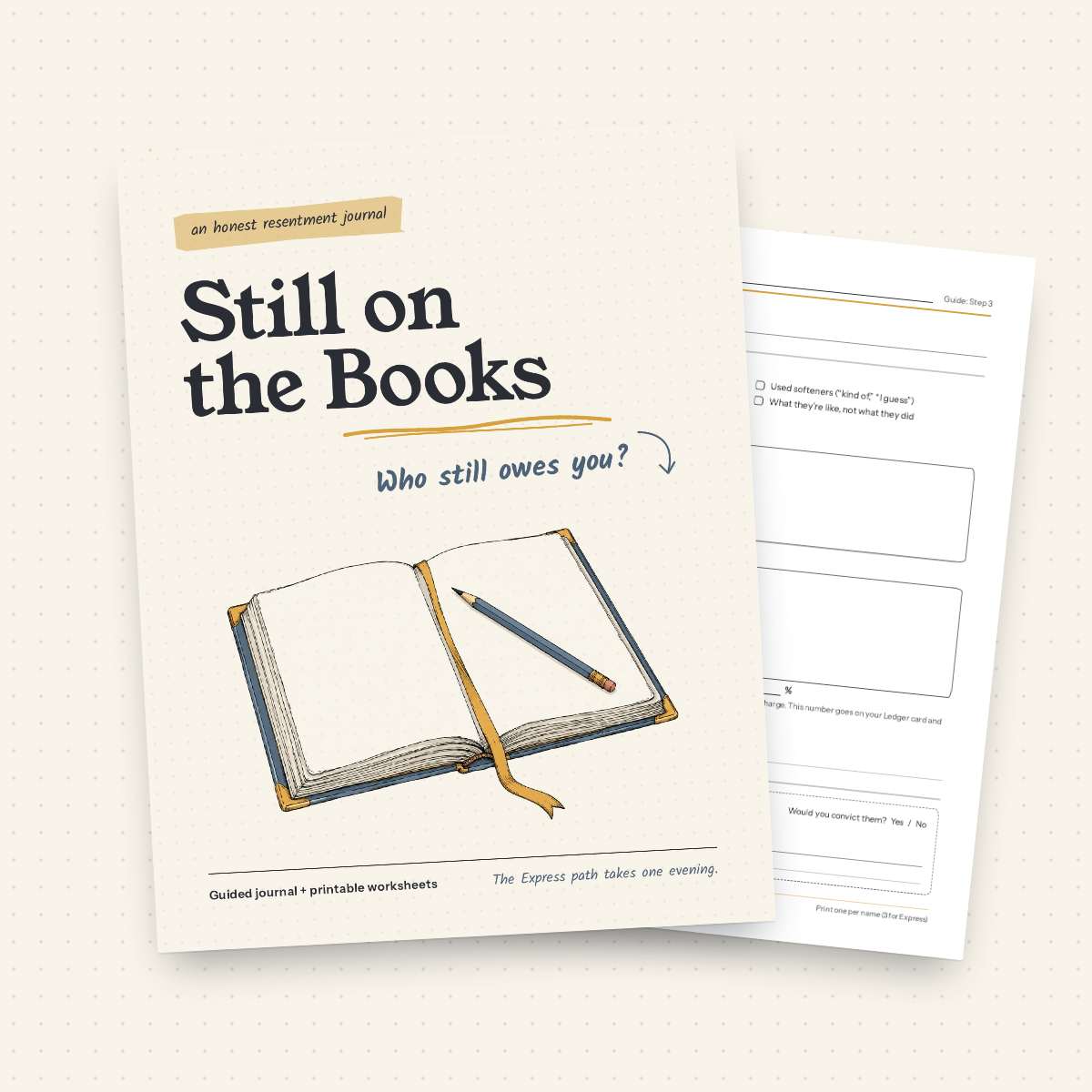
- Start Here (1 page). Four moves for tonight.
- The Guide (37 pages). The instructions, the checks, and worked examples.
- The Worksheets (27 pages). Printable writing space for every step. Tonight you only need about 7 pages. Rather use your own journal? Skip the printer and copy the headings.
The Express path takes one evening.
Steps 1 to 5, about 60 to 90 minutes, in one sitting if you can:
- Find the names. Ten fast questions, names only.
- Pick your top three.
- Get to the real charge.
- The Ledger: a job and a first step for every entry.
- Finish line.
You finish with three real charges, a job for each, and a first step for each. That is a finished audit.
The Full path is optional.
Use it when an entry won't settle, more names keep surfacing, or you want the pattern under all of it. It adds:
- Ten more questions.
- Nine modules for specific kinds of injury: It Was My Call, Used, Passed Over, Not There, Not Chosen, Set Up to Fail, Betrayed, Made Small, Misjudged.
- Four special cases: No Face, God or the Universe, Not Really a Charge, The Self Ledger.
- Five more tests.
- A second pass, 48 hours later.
Start with Express. By the end of it you'll know whether you need the rest.
The Guide also includes three worked examples. They are fictional composites, not customers.
A note from the person who made it
I built it around the apology test because it's what cracked my own inventory open. Writing the apology I needed from one person showed me the charge was about something other than the incident I'd been replaying for decades, and that what I owed that entry was grief, not forgiveness.
Yours may go differently. That's what the audit is for.
Practical Woo
Who this is for, and who it isn't
For: the ordinary, stubborn stuff. The boss, the friend who drifted, the sibling who got the better deal, the version of you that should have known better. The dead are eligible, and so are you.
Not for: anything involving abuse, assault, violence, or something you've never been able to talk about with anyone. Write "not this book" next to that name and move on. Those deserve a real person in the room, such as a counselor, pastor, or someone trained for it.
It also has a stop rule: stirred up is expected, shaken means stop for the day. If working through it brings up thoughts of harming yourself, put it down and talk to someone now. In the US, call or text 988.
Still on the Books is a journal, not therapy, and no substitute for a professional if you need one.
The guarantee
14 days, no questions. If it isn't for you, ask for a refund.
And if you do the work, you get longer:
Do two things. First, finish Express Steps 1 to 4 on your top three names (60 to 90 minutes). Second, do the first act you wrote down for each one. If, within 30 days, you can't point to a single entry that has moved, because you know what it needs from you or it's closed, email me. I'll refund you and you keep everything.
$27
One-time payment. Instant download. Print what you need, or write in your own journal.
Not ready? Start with the free five questions: Who Still Owes You?
Questions
Do I need a printer?
No. The Worksheets are for printing, but you can copy the headings into your own journal.
How long does it take?
The Express path is about 60 to 90 minutes, in one sitting if you can. The Full path is optional and takes 2 to 4 more sittings of 45 to 90 minutes.
Do I have to forgive anyone?
No. Forgiving is one of six possible jobs. Some entries need grieving, a boundary, or a change in your own behavior.
What if the person has died?
They're eligible. If you're still arguing with them, they go on the list.
What if my grudge is with a company, the government or God?
The Full path has pages for entries with no face, and for resentment toward God or the universe. It works whatever your faith or lack of one.
What if I'm still in the middle of it?
Entries that are still happening usually end in a boundary, not forgiveness. The book walks you through that.
Is this therapy?
No. It's a journal. If a name involves abuse, assault or violence, skip it here and talk to someone trained.